


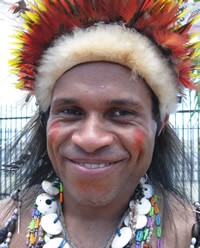

The Barai are a small people group of about 1,500 individuals living in Papua New Guinea's Central Province (Rigo District) and parts of Oro Province (Afore District) in villages such as Itokama, Madokoro, Naokanane, and Umuate. Their community identity has been shaped by generations of village life in forested inland and coastal areas west of the Moni River and on the Managalas Plateau, where families have maintained distinct cultural patterns within the broader New Guinea cultural mosaic.
They speak the Barai language, a Trans–New?Guinea language of the Koiarian branch that remains in daily use among the community, with two main dialects including Birarie.
The Barai live in rural inland and forest edge villages where subsistence activities and local cooperation shape daily life. Families garden for staples such as root crops, bananas, and vegetables, supplementing food supplies by fishing and gathering from nearby rivers and forests. Homes are typically built from materials gathered locally, including timber, palm thatch, and thatch roofing.
Because the region has limited formal infrastructure, transportation beyond village paths and small local tracks is constrained. Access to formal education beyond primary level and healthcare services generally involves travel to larger towns. Extended family networks and cooperation among neighbors are central to sustaining daily rhythms, including shared work on gardening, shelter maintenance, and childcare.
Almost all of the Barai identify as Christian, though only a portion are classified as evangelical believers, suggesting that while Christianity is widely professed, a deeply biblical understanding of the gospel may vary among individuals. Traditional spiritual beliefs involving unseen forces linked to nature and community life may still influence how some interpret health, misfortune, and other life events alongside Christian identity.
In their Barai language, portions of scripture including Bible portions and the New Testament have been translated and are available in written and digital forms, though the complete Bible is not yet finished. Resources such as online text, audio Bible apps, and teaching materials exist, but full access to all of God's Word in Barai remains limited compared to larger languages.
The Barai need a clear and faithful presentation of the gospel of Jesus Christ that leads to genuine personal faith and spiritual growth rooted deeply in Scripture rather than mixed with traditional belief systems. Where Christianity is present, discipleship and continuous biblical teaching are essential for meaningful spiritual maturity.
A significant need is the completion and broad distribution of the Bible in the Barai language, so that individuals and families can engage directly with all of Scripture in the language used in their daily life.
There is also a need for trained local leaders who can teach sound doctrine, disciple believers, and help strengthen church life that reflects biblical truth.
Practically, improved access to healthcare, education, and reliable transportation would support physical well?being and expand opportunities for long?term spiritual and community development in their rural inland context.
Pray that the Barai people would come to a clear and saving faith in Jesus Christ.
Pray that those who identify as Christians would grow in deeper biblical understanding and apply God's Word to everyday life.
Pray for the completion and availability of the full Bible in the Barai language so the community can engage fully with God's word.
Pray for faithful local church leaders to be raised up who can teach, disciple, and shepherd others.
Pray that traditional spiritual beliefs would be replaced by confidence in the truth of Scripture.
Pray for improved access to healthcare, education, and transportation to support overall community wellbeing.
Scripture Prayers for the Barai in Papua New Guinea.
| Profile Source: Joshua Project |


